For businesses in the advanced engineering and science industries, SEO isn’t about chasing clicks – it’s about reaching the right people.
What is SEO – and why does it matter in the technical sector?
SEO – Search Engine Optimisation – is about visibility. It’s a vital tool in helping your website appear higher up on Google (and other search engines) when potential customers or employees are looking for a particular business or service. For advanced scientific and engineering businesses, SEO is about reaching your specialist target audience – whether that be potential customers, technical buyers, or potential and existing staff. Effective SEO should put your company onto page 1, where your audience will be looking.[1]
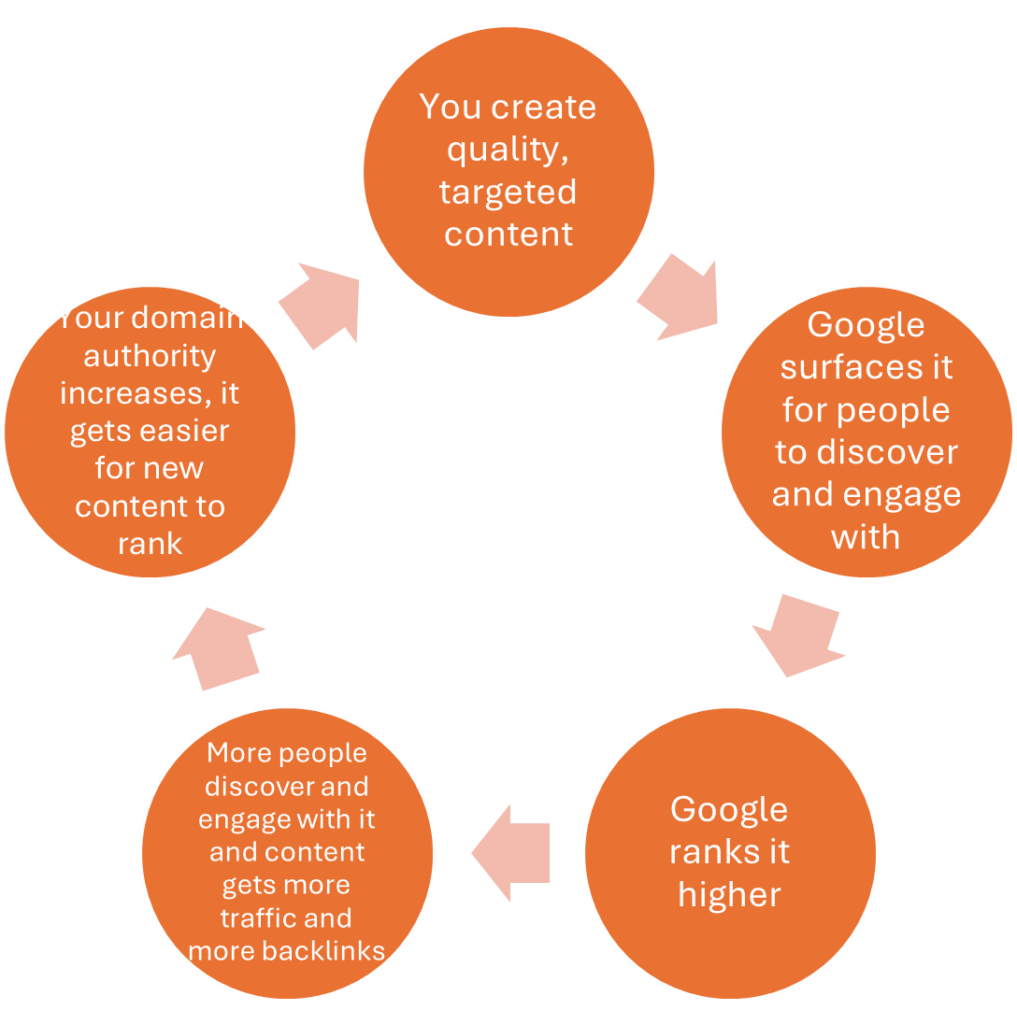
Understanding keyword search – the language of your buyers
A key element of SEO is understanding the language the people you want to be interested in your business are using when searching online as, in advanced technical sectors, visibility can be lost. Getting this right ensures your audience know that you talk their language and understand their needs.
User intent – or search intent – is critical. You want to know what your audience is actually looking for. And Google’s algorithms are designed specifically to interpret intent. Simply put, if your keywords hit the right spot, you’ll rank higher.
Keyword research reveals the exact words and phrases people use when looking for information. This insight helps businesses understand the needs and desires of their target audience. By knowing the keywords that match user intent, you can create content that directly addresses the needs of your audience, increasing the likelihood of engagement and conversions.
Short- or long-tail?
There are two main types of keywords. You can have ‘short-tail’ or ‘long-tail’. Short-tail are the most popular because they are less specific and therefore searched for the most often (for example, ‘engineering’). Though short-tail keyword research is highly effective in reaching a large number of people, it can skew your website’s analytics with a high bounce rate and low engagement. And are they the right people?
Long-tail keywords are more specific and therefore searched for less frequently. Nevertheless, long-tail searches (e.g., ‘oil and gas engineering’) often reach a more specific, and relevant, audience. Around 70% of all searches today are made using long-tail queries, so, whilst they can be more complex to identify, it is well worth nailing your long-tail searches to incorporate them into your website.[2]
Once you’ve decided on your keywords, what should you do with them?
While there are many ways to optimise the performance of your website, incorporating keywords into the title tag (the title of the web page, the URL- the address of the web page) is a simple but effective starting point. Keywords should feature across your website, of course, but the research you’ve done to select them should inform your whole marketing strategy. Incorporate them into all your marketing communications – press releases, social posts, and advertising (particularly in any paid social campaigns, and in Pay Per Click where they can significantly impact your budget).
Creating case studies that support SEO and credibility
For companies in the advanced engineering and science sector, case studies are crucial for SEO success.
Case studies boost visibility and reach and demonstrate authenticity – clearing a path to long-tail searches that don’t fit naturally onto broader service pages. Your credibility matters just as much as your discoverability – buyers want to understand the type of work your business has delivered, supported, and is capable of achieving.
Creating in-house case studies means documenting and sharing real examples of how your team has tackled complex challenges and delivered results, making your company’s problem-solving skills visible to potential clients. Case studies demonstrate your specialist approach and capabilities, helping buyers understand why your solution best fits their needs and how you stand out against your competition.[3]
At Aro, we encourage our clients to incorporate case studies into their day-to-day marketing, and we have seen huge success in how this improves website traffic, engagement, and brand visibility. If you want to maximise your SEO success, case studies should be a key element of your strategy.
On-page SEO: making each page clear, relevant and accessible
So, you’ve written your case studies, and you’ve done your keyword research – what’s next?
Now that you’ve laid the foundations for SEO success, it’s time to ensure that each page of your website is structured in a way that search engines – and potential customers – can easily understand.
This is where on-page SEO comes in.
At its simplest, on-page SEO is the process of optimising the structure and content of webpages (primarily text, images, and videos) to increase the likelihood of showing up in traditional search and AI generated results. Examples of on-page SEO tasks include strategically placing keywords in content and writing accurate title tags.[4]
Having a bank of case studies and nailing your keyword research are key in producing clear and valuable on-page SEO, so, you should be well on your way to SEO success already!
So, what actually works for advanced engineering and scientific organisations?
When implemented strategically, SEO makes a business accessible – laying the foundations for communication and trust. But what actually works for advanced engineering and scientific organisations?
Understanding keyword search, the impact of case studies and how to perfect on-page SEO are the stepping stones to SEO success. By nailing these key drivers, advanced scientific and engineering organisations can optimise visibility – directing target customers/employees/suppliers to their online services on a larger and more rapid scale.

Our chief Barketing officer, Bruno, is chasing his longtail keyword search for SEO success – we hope you are too!
If you’d like to explore how Aro could help you optimise your SEO, or just to have an informal chat around generating opportunities and perfecting your online marketing, get in touch for an initial chat:
email info@aroprandmarketing.co.uk or phone 0117 379 0008.
[1] Wordstream (2024). WordStream: Online advertising made easy. [online] Wordstream.com. Available at: https://www.wordstream.com/.
[2] Analytify. (2025). How To Find Best Long-Tail Keywords For SEO (2026 Guide). [online] Available at: https://analytify.io/long-tail-keywords/ [Accessed 13 May 2026].
[3] engineeringx.raeng.org.uk. (n.d.). Case studies. [online] Available at: https://engineeringx.raeng.org.uk/scs-case-studies.
[4] Pavlik, V. (2026). What Is On-Page SEO? And How to Do It. Available at: semrush.com.